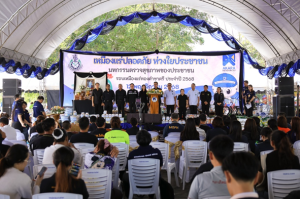

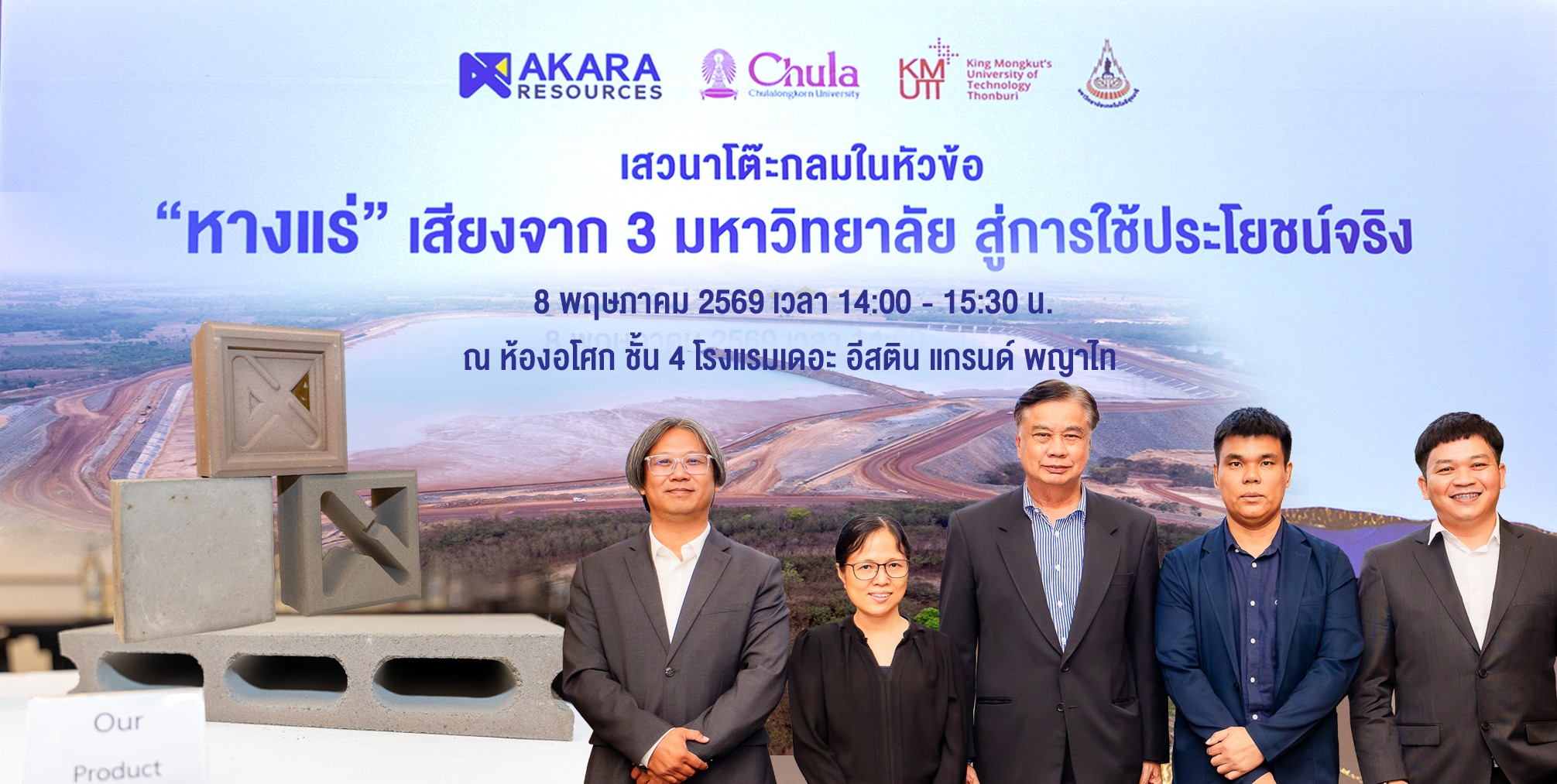
Akara Resources Public Company Limited, operator of the Chatree Gold Mine, has partnered with three leading academic institutions—Chulalongkorn University, King Mongkut’s University of Technology Thonburi (KMUTT), and Suranaree University of Technology (SUT)—hosted a roundtable discussion titled “Tailings: Voices from Three Universities to Real-World Applications” on 8 May 2026.
The event also unveiled progress on three prototype research projects aimed at transforming “tailings” from gold and silver production into “alternative resources.” The initiative focuses on repurposing residual materials from the production process into upstream raw materials, reducing the consumption of new natural resources and creating tangible value across the construction, energy, and community enterprise sectors, in direct support of the Circular Economy.

Bridging Research and Real-World Application
This collaboration reflects Akara’s ongoing strategy of supporting academic research through practical access to its mining operations. Researchers are able to collect and study tailings samples to better understand their properties and develop innovations that can be applied in construction, energy and community-level applications. Beyond unlocking new value, the initiative also reinforces Akara’s commitment to systematic safety standards, in accordance with Environmental Health Impact Assessment (EHIA) framework.

Mr. Cherdsak Utha-aroon, General Manager of Sustainability at Akara Resources Public Company Limited, said: “Our goal is to ensure that existing resources are used to their fullest potential. Through our collaboration with the three universities, materials that were once overlooked, like tailings, are now being studied and developed into viable alternatives for both the construction and energy sectors. We also aim to see these innovations applied at the community level to create jobs, generate income, and expand economic opportunities, ultimately reducing inequality and improving quality of life in a sustainable way.”
Three Innovation Models: Turning Tailings into New Industrial Opportunities

KMUTT: Led by Asst. Prof. Dr. Thidarat Bunsri, Leader of Biosmart Materials and Technology Research Group at the Faculty of Science, began by validating the safety of tailings storage facilities. The findings confirmed structural stability and no risk of leakage, consistent with EHIA standards. Building on this, the team developed “bio-cement,” combining tailings with industrial by-products such as eggshells and microorganisms derived from fish sauce waste. The result is a low-energy material that does not require high-temperature processing and offers enhanced salt resistance and self-healing properties. This patented innovation is already being applied in the form of saltwater barrier panels to support farmers in northeastern Thailand and is being further developed into irrigation drainage systems, with planned pilot applications in collaboration with the Royal Irrigation Department in Uttaradit and at the Chatree Gold Mine.

Chulalongkorn University: Dr. Peet Homchuen from the Department of Mining and Petroleum Engineering, Faculty of Engineering, found that tailings processed during gold production already possess fine particle characteristics suitable for use as construction inputs. The research team developed low-carbon construction materials, including concrete blocks and ventilation bricks, with tailings comprising approximately 25–75% of the mix. These materials not only demonstrate strength and durability but also benefit from the ready-to-use particle characteristics of the tailings, eliminating the need for additional processing. This significantly reduces both production costs and energy consumption, supporting greenhouse gas reduction and net-zero targets. The project is currently being scaled up from laboratory research to a pilot-scale production, with plans to transfer knowledge to communities to support income generation and long-term self-reliance.

Suranaree University of Technology: Asst. Prof. Dr. Boonnarong Arsairai from Geotechnology at the Institute of Engineering, is exploring the use of tailings as an additive in specialized cement for petroleum exploration and production. Such application requires materials that can withstand high pressure and prevent leakage over extended periods. The research found that adding just 3% tailings significantly enhances strength, reduces porosity, and improves the long-term durability and lifespan of the cement. The findings highlight the potential of tailings to serve in high-performance industrial applications that demand internationally recognized safety standards. The project is currently being evaluated for commercial application.
Advancing New Opportunities Through Tailings Innovation
The combined research efforts from all three institutions demonstrate the potential of tailings to become alternative resources for the future, capable of delivering tangible value and supporting practical industrial applications.

Mr. Phuriwit Sangsiri, Head of Science and Health at Akara Resources Public Company Limited, said: “Research insights from these studies allow us to better understand the technical requirements and optimal proportions for utilizing tailings effectively. This is a critical step in ensuring that these materials can be developed into new innovations that meet high safety standards and deliver real benefits at both industrial and community levels.”

Akara will continue to collaborate closely with all three universities to advance these innovations from prototype to commercial application. At the same time, the Company is working with relevant government agencies to support certification and broader industry adoption, and to transfer knowledge to local communities. These pilot projects serve as important case studies, demonstrating how existing resources, when developed using scientific evidence, can be transformed into practical, scalable solutions that contribute to sustainable value across economic, social, and environmental dimensions.